
Ryan Rotar began his career in healthcare before he was old enough to drive. At the age of 15, his mom asked him if he could lift 50 pounds and push a gurney. The hospital where she worked had just lost a transporter and needed a fill-in on the weekends. “So, Saturday morning I reported to the hospital in a pair of oversized scrubs and started as a radiology transporter,” Rotar recalls. “I’ve never looked back since.”
Over the next three decades, Rotar moved through radiology, the operating room, supply chain leadership and enterprise IT, building an unusually broad view of how hospitals function. He held operational and technology leadership roles at Avera Health and Essentia Health before joining UNC Health, where he helped oversee complex supply chain operations and modernize business systems as Executive Director of Supply Chain operations and Director of IT for ERP Systems.
Now Vice President of Healthcare Market Strategy at Tecsys, Rotar draws on his comprehensive experience to help health systems rethink how supply chain performance affects case readiness, clinician workflows and patient care. Following his recognition as one of Supply & Demand Chain Executive’s 2026 Pros to Know, we spoke with Rotar about how his years in scrubs continue to shape his views on supply chain modernization — and why many health systems still struggle to get it right.
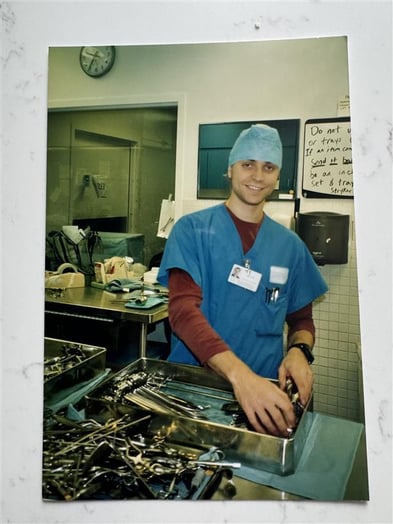 Ryan Rotar at the Torrance Memorial Medical Center in the early 2000s
What was your impression of the hospital when you began working there as a teenager? Were you surprised by how things operated?
I think I was a little confused. I literally grew up in healthcare. My mom started working in healthcare when I was single digits old, so when I had an unexpected day off from school or when staff had parties, I would just come to work. I knew the physicians, I knew the staff, I knew everybody, so that world was pretty well known to me on one level.
But as I became a transporter, the business of healthcare was more difficult to understand. I came in right around a changeover period. I’m what they call an Xennial, so I kind of bridged the gap between analog and digital. I saw clinical orders come down on faxed handwritten paper and then change over to electronic records. I watched hospital standard practices be generated, saw the electronic medical record take off and watched x-ray change from film I had to develop to an image on a screen.
I’d been a customer of healthcare — playing ice hockey will get you sent to the hospital plenty of times — but I had never seen how it functioned behind the scenes. I think what’s unique about me is that I’ve worked in so many areas of the healthcare system. That gives me a perspective a lot of even senior executives frankly don’t have, because they’ve stayed in supply chain or stayed clinical or stayed in IT, while I’ve worked in all of those fields. Each area I worked in and each new task I learned empowered the next. My first decade in healthcare really focused on collecting experience and understanding.
How did that clinical experience change your perspective as you transitioned to the business side?
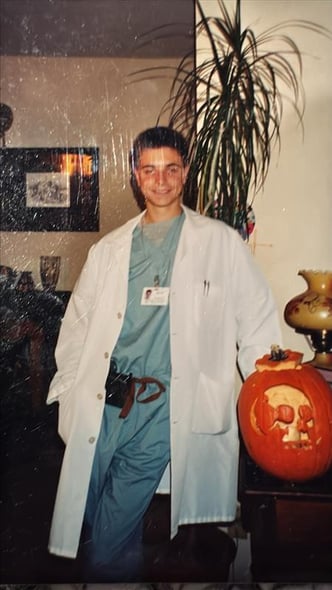
I was a surgical instrument tech then trained to become a surgical tech, so in total I spent ten years in an OR setting.
What I learned pretty quickly was what can go wrong in a case from a non-clinical perspective. For example, case carts would come to the OR and instruments would be missing from trays, products wouldn’t be on the carts and chaos would ensue. I learned to prevent that. I also saw that there was a lack of understanding of what’s upstream and downstream of an operating room or really any care setting. So, I started focusing on the things that could add more value to my role. Can I help clean up preference cards? Can I actually update them? Are there too many instruments in these trays, or too few, or the wrong ones? Can we put that into a system so it’s sustainable? Can I bolster inventory in supply chain for products that are generally not available or show up late?
During my time on the clinical side, I learned the things that stop cases and impact patient care and I still use that knowledge now when I’m working with clients, because if that stuff’s not there, when there’s a breakdown in the process, the result is that you’re delaying care.
Can you give me a sense of how seriously health systems take issues like case carts and preference cards? They obviously talk about them, but are they really working to address them?
I think most people see there’s value to be gained by correctly managing preference cards and optimizing the case cart process. They generically understand those are positive things to do and may even start an initiative to improve, but a lot of people don’t know exactly how to operationalize that improvement.
The biggest issue I see is that the person who holds the keys to make those changes might not have the respect, relationships or ability to make those changes in an effective way. Additionally, I see many organizations struggle to make improvements in a sustainable way. They may have done some transformation work, but the culture wasn’t one that supported continuous change. Each health system has its unique set of challenges, but a commonality is that the key to sustainable change is to build a strong relationship between clinicians, supply chain and IT. The political, relationship-based piece is incredibly important but many times there’s no effort to engage until there’s a huge problem.
Is the solution to these issues fairly similar across systems, or does it vary a lot depending on the makeup of the system?
There’s a running industry joke that nobody has clean preference cards; everyone can always clean up inventory more, and I think that kind of applies here. I could go talk to 100 healthcare systems — and I probably have over the course of my career — and I don’t think anybody says they have it figured out.
The issues are standard across the board. The severity may vary, but preference card accuracy, stockouts, OR case picking, returns, clinical case documentation, chargemaster issues — these are all things healthcare systems are perpetually challenged with. Just because last Friday we all had a pizza party and said it’s perfect, it doesn’t mean today, tomorrow and next week it is. This takes continual action. This is not the Ron Popeil rotisserie oven. You do not set it and forget it.
You’ve been making the case that supply chain is intrinsically connected to patient outcomes. Is that a message most systems understand and are open to hearing, or are they still not thinking about supply chain that way?
It’s a spectrum. On the higher end, where you have what’s called a clinically integrated supply chain, there are people and teams and processes that are geared toward providing high-quality, safe, predictable patient care and recognize that tie to supply chain. There’s a culture of accountability and clinically integrating business services to the point of care.
But those systems are few and far between. And even in those places, it’s still a journey. As much as we like to talk about how everybody understands the connection — that clinically we can’t do our job if supply chain and business services don’t do their job, and that business services understands everything is ultimately for the patient — I often find there are still silos. So, there may be an intellectual understanding of a desired outcome, but there’s no action taken on improving the connectivity between clinical and operational. And that’s where people like me and a number of others across the industry are trying to bridge the gap.

What role does technology play in all of this? Are there possibilities that technology enables that the C-suite may not fully understand yet?
I think a lot of people settle for mediocrity. There are a lot of supply chain leaders and C-suite leaders who think they are absolutely crushing it as long as there are no major failures, and nobody looks too closely. Unfortunately, the bar is set very low in that regard. I think when leaders have limited exposure to other healthcare systems, and different ways of improving a supply chain, mediocrity can start to look pretty good.
I do think when you get progressive, broadly educated senior leaders — for example, physicians with a business degree or operations folks who got more clinically involved — you start looking at healthcare as a whole rather than through a siloed view. You start to see there actually are solutions that can help and have a meaningful impact.
But it takes somebody being inquisitive enough to understand the underlying issues and that there are niche technologies that sit between clinical and operations. It takes a champion who can not only explain things clearly but also lead to proposed changes or software implementation. Right now, the market is saturated with software providers and AI companies which often overwhelm potential customers to the point that many of them assume any new technology is just smoke and mirrors or that the ROI would be minimal. There are so many bespoke solutions focused on one little pain point — revenue cycle, preference cards, instrument tracking, tray optimization, equipment tracking, etc. — that some executives back up and stay away because introducing 15 different pieces of technology doesn’t seem feasible.
When vendors that have robust solutions are able to get in front of senior leaders and demonstrate their effectiveness and how they can assist in a meaningful way, progress can be made. But it takes more work than you’d think to explain to the right people what value can be gleaned from a particular solution, and then even more time explaining to senior leaders what supply chain even is and why it matters.
C-suite leaders are quickly learning how impactful a supply chain can be not only to the bottom line but as a competitive advantage both financially, operationally and clinically.
If you’re a health system beginning to come around to the idea that there are real benefits to modernizing your supply chain, where do you start?
There’s no right answer. That’s part of the fun of working in supply chain in healthcare. No two days are the same. You’re solving similar problems in very different ways. No two customers are exactly alike either. One customer might be experiencing significant shrink in inventory; another might be having an issue keeping items updated in their systems, others might struggle finding actual people to do the work, or they might need data cleanup, or all of the above.
So, when I get into these conversations and start asking why they think they need technology and what their pain points are, they’re never exactly the same. As I’ve had the opportunity to connect with well-performing operators all over the country, I’ve seen over and over that those who succeed understand that everything in healthcare is connected. The more people start to look at the practice of healthcare as a value chain, the more they can expect to see improvements. The best way to start is to go learn new things, build relationships, go observe where the work happens and don’t be afraid to make some changes. Trying something new and failing is still a win because you learned something.
Read more perspectives on healthcare supply chains in our resource center.