
The FDA has finalized one of the biggest changes to National Drug Codes in decades. Beginning March 7, 2033, FDA-assigned NDCs will move to a uniform 12-digit format.
That deadline may feel distant, but the format change needs to be planned carefully. NDCs sit inside many of the systems and workflows health systems rely on every day. They appear in pharmacy inventory data, vendor feeds, barcode scanning, receiving, replenishment, reporting and compliance processes.
Here is what hospital pharmacy and supply chain leaders should know.
What is changing with NDCs?
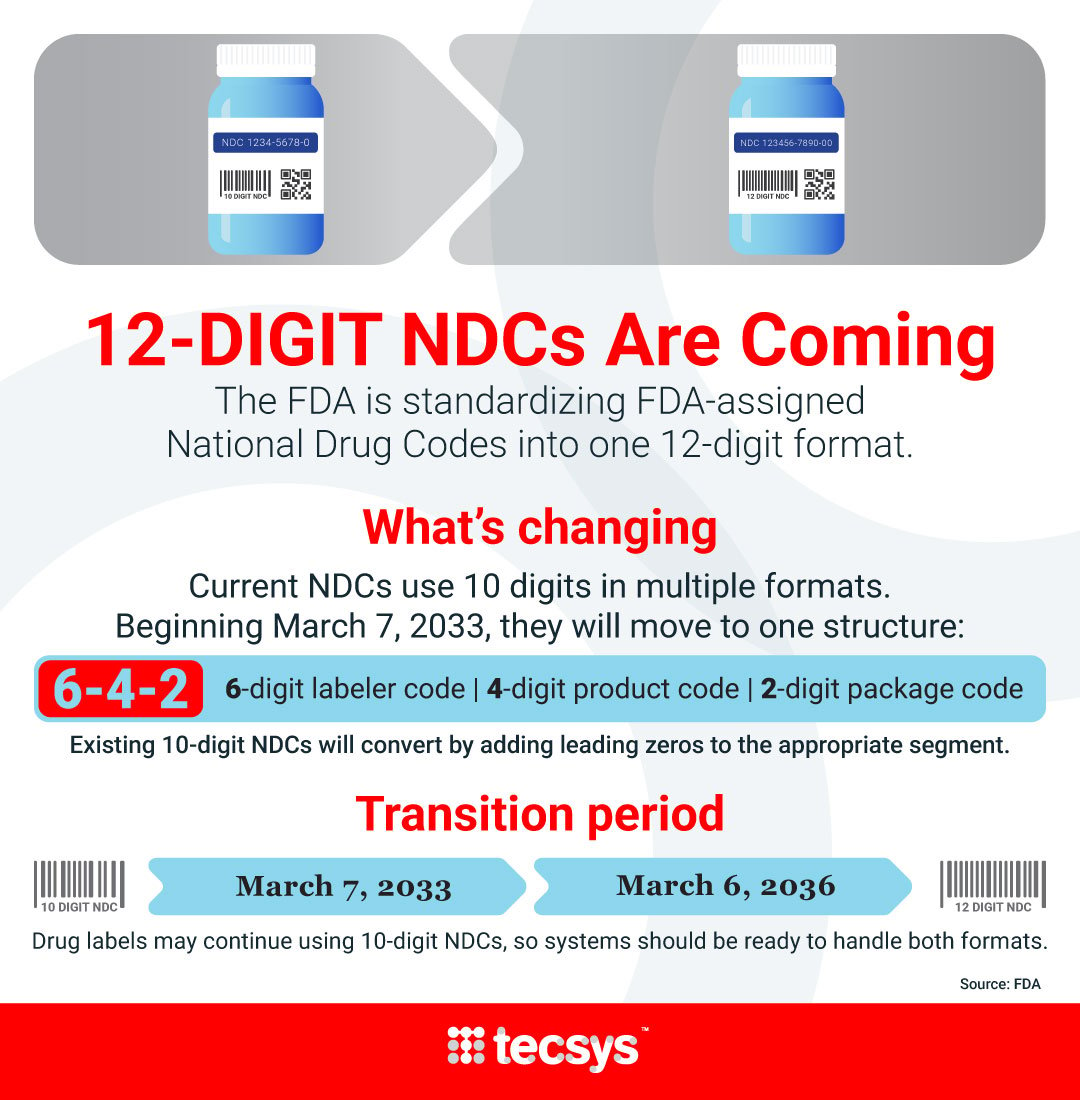
The FDA is standardizing FDA-assigned NDCs into a single 12-digit format.
Today, FDA-assigned NDCs are 10 digits and can appear in several configurations: 4-4-2, 5-3-2 or 5-4-1. Under the new rule, they will move to one consistent 6-4-2 structure:
-
Six-digit labeler code
-
Four-digit product code
-
Two-digit package code
The three-part structure remains. The change is that every FDA-assigned NDC will follow the same length and segment pattern.
When does the 12-digit NDC rule take effect?
The rule takes effect on March 7, 2033.
Until then, FDA will continue assigning 10-digit NDCs in the current formats. On March 7, 2033, FDA will begin assigning new 12-digit NDCs and will convert previously assigned 10-digit NDCs to the new 12-digit format.
FDA is also allowing a three-year transition period for drug labeling updates, from March 7, 2033, through March 6, 2036. During that period, FDA says it does not intend to object to continued use of 10-digit NDCs on drug labels.
Why is FDA changing the NDC format?
The current NDC structure creates avoidable variation. FDA-assigned NDCs use multiple 10-digit formats, while other parts of healthcare often rely on standardized 11-digit formats for reimbursement and related purposes.
That variation can require format conversion across systems. It can also create room for errors when leading zeros are dropped, added in the wrong place or handled inconsistently.
The 12-digit format is intended to reduce that variation over time by giving FDA-assigned NDCs one consistent structure.
Does this create a new NDC for each drug?
No. FDA has stated that converting a 10-digit NDC to the 12-digit format is an administrative format change, not the assignment of a new NDC.
The conversion is handled by adding leading zeros to the appropriate segment or segments. Those zeros are not always added to the front of the full number. The correct placement depends on the current NDC configuration.
For example:
-
A 5-4-1 NDC becomes 6-4-2 by adding one leading zero to the labeler code and one leading zero to the package code.
-
A 5-3-2 NDC becomes 6-4-2 by adding one leading zero to the labeler code and one leading zero to the product code.
-
A 4-4-2 NDC becomes 6-4-2 by adding two leading zeros to the labeler code.
How could this impact hospital pharmacy inventory?
NDCs are part of the data structure behind many pharmacy inventory activities. A change in length can affect how systems store, recognize, scan, match and report medication data.
-
Health systems should look closely at workflows involving:
-
Item master data
-
Wholesaler and vendor catalog feeds
-
Barcode scanning and receiving
-
Pharmacy automation
-
340B workflows
-
DSCSA-related processes
-
Billing, reimbursement and reporting
-
Interfaces between pharmacy, supply chain, finance and clinical systems
The main risk is not the FDA deadline itself, but inconsistent data handling during the transition, especially when some products, labels, feeds or systems may still reference older formats while others move to 12 digits.
Will health systems need to support both 10-digit and 12-digit NDCs?
Yes. FDA encourages affected parties to prepare for the transition and says systems should be able to handle both 10-digit and 12-digit NDC formats during the three-year transition period from March 7, 2033 through March 6, 2036.
For hospitals and health systems, that means readiness should include more than field length. Teams should understand how their systems will map old and new formats, preserve leading zeros, recognize equivalent NDCs and prevent duplicate or incomplete item records.
How does this relate to barcodes and DSCSA?
FDA is also revising drug barcode label requirements. Under the rule, linear or nonlinear barcode formats may be used to encode the NDC if they conform to FDA-recognized standards.
For DSCSA product identifier requirements, FDA says a 2D data matrix barcode can encode the 12-digit NDC using GS1’s application identifier 715, along with other required data elements such as serial number, lot number and expiration date.
Beginning March 7, 2033, a single 2D data matrix barcode may satisfy both the NDC barcode label requirement and DSCSA product identifier requirements when applicable.
What should health systems do now?
A practical readiness review should start with five questions:
-
Where do NDCs appear in our pharmacy, supply chain, finance and clinical workflows?
-
Which systems store, scan, transmit or validate NDCs?
-
Can those systems handle 12-digit NDCs without dropping leading zeros?
-
How will we manage older and newer NDC formats during the transition period?
-
What are our wholesalers, software vendors and automation providers doing to prepare?
The best first step is a simple inventory of systems and data flows. Once health systems know where NDCs live today, they can decide what needs to be tested, updated or monitored ahead of 2033.
How can Tecsys support the change?
Tecsys’ Pharmacy Inventory Management System (PIMS) already supports expanded NDC length across item master data and transactional workflows. PIMS can be configured to recognize relevant NDC formats in activities such as scanning, receiving and inventory transactions, helping customers maintain continuity as 10-digit and 12-digit formats coexist during the transition.
Current customers preparing for the change can contact their Tecsys representative for guidance on how NDC formatting is handled in their environment. Healthcare organizations reviewing pharmacy inventory readiness can also connect with Tecsys to learn how PIMS supports medication inventory visibility, traceability and control.
What is the main takeaway?
The FDA’s 12-digit NDC rule gives the industry a long runway. Health systems should use it.
The deadline is years away, but the systems affected by the change are already in place. Health systems that use the runway to review NDC data, scanning workflows and partner feeds will be in a stronger position when 12-digit NDCs begin moving through daily pharmacy operations.